
하와이주 교육부의 예산은 학생의 성공을 지원하고 공립학교 시스템의 질을 유지하는 데 중요한 역할을 합니다. 저희 예산은 운영 예산과 자본 개선 프로그램(CIP) 예산의 두 가지 주요 부분으로 나뉩니다.
Appropriation → | → Allocation → | → Allotment → | → Expenditure |
Resources that have been or are in the process of being approved by the Legislature and have become law. (Legislative Reference Bureau – The Budget Process) | Appropriation amounts provided (“allocated”) to programs to create expenditures plans. Allocated amount could be less than Appropriation due to restrictions set forth by the Governor or by the Department depending on the fiscal conditions of the time. | Once the Expenditure plans are completed and approved, resources are loaded (“allotted”) into the Financial Management System allowing programs to begin spending their allotted resources. | Actual use of the resources for payroll and by either purchasing or encumbering goods or services. |
The $2.37 billion operating budget for fiscal year 2026-27, primarily funded by state tax revenue, covers the day-to-day operations of schools and offices, from teacher salaries to classroom resources. Meanwhile, the CIP budget focuses on the development, maintenance and upgrading of school facilities, funded almost entirely through state bonds.
Together, these budgets ensure that our schools are equipped to provide a safe, engaging and effective learning environment for all students. Learn more about the Department’s budgets below.
TIMELINE
This is a timeline of major events of the Department’s operating budget appropriations.
날짜 | 조직 | Description |
|---|---|---|
10/8/2026 | 교육부 | |
10/8/2026 | 교육위원회 Finance and Infrastructure Committee meeting | Proposed Biennium 2027-29 Budget Request: • Operating Budget – Agenda Item IV • CIP Budget – Agenda Item V |
9/9/2026 | Department of Budget and Finance | FM 26-08 Fiscal Biennium 2027-29 Executive Budget Request and the Program and Financial Plan for the Period 2027-33 • Attachment 1 • Attachment 2 • Attachment 3 • Attachment 4 • Attachment 5 • Attachment 6 • Attachment 7 |
9/3/2026 | Department of Taxation | The Council on Revenues held a meeting to forecast revenue growth for the General Fund on September 9th, 2026. • The Council raised its forecast for Fiscal Year (FY) 2027 growth rate from 1.0% to 2.5% and its forecast for FY 2028 from 1.9% to 3.0%. The growth forecast for FYs 2029 through 2032 were revised as follows: from 2.5% to 3.0% for FY 2029, from 1.8% to 1.7% for FY 2030, from 3.1% to 3.7% for FY 2031, and from 3.4% to 3.3% for FY 2032. Finally, FY 2033 forecast was set as 3.7%. • Presentation |
8/3/2026 | Department of Budget and Finance | |
6/26/2026 | Governor | HB1800 Budget Bill signed into law and enacted as ACT 175, SLH 2026 • DOE programs (EDN 100, 150, 200, 300, 400, and 500) start on page 41. • All GIAs are under the Office of Community Services (LBR903) start on page 67. • Capital Improvement Projects with EDN program codes start on page 188. |
5/22/2026 | 교육부 | HB1800 CD1 Legislative Budget Worksheets with annotations from the Budget Branch. |
5/22/2026 | Hawaiʻi State Legislature | House Finance and Senate Ways and Means releases Committee Report and bill format of budget bill HB1800 CD1 (Worksheets to be released later). • Budget Worksheet (see EDN 100, 150, 200, 300, 400, and 500) |
5/21/2026 | Department of Taxation | The Council on Revenues held a meeting to forecast revenue growth for the General Fund on May 21st, 2026. • The Council raised its forecast for Fiscal Year (FY) 2026 growth rate from -4.5% to -2.5% but lowered its forecast for FY 2027 from 2.0% to 1.0%. Otherwise, the Council kept the forecast for FY 2028 through FY 2032 unchanged from the projections adopted at its three previous meetings on January 7, 2026, September 4, 2025, and March 10, 2026. • Attachment 1 • Attachment 2 • Attachment 3 • Presentation |
5/14/2026 | 교육위원회 일반 사업 회의 | Updates on 2026 legislative session: • Operating Budget – Agenda Item VI • CIP Budget – Agenda Item VII 그리고 Agenda VIII |
4/14/2026 | Hawaiʻi State Legislature | Senate Ways and Means releases Committee Report and bill format of budget bill HB1800 SD1. • Budget Worksheet (see EDN 100, 150, 200, 300, 400, and 500) |
3/16/2026 | Hawaiʻi State Legislature | House Finance releases Committee Report and bill format of budget bill HB1800 HD1. • Budget Worksheet (see EDN 100, 150, 200, 300, 400, and 500) |
3/10/2026 | Department of Taxation | The Council on Revenues held a meeting to forecast revenue growth for the General Fund on March 10th, 2026. • The Council raised its forecast for Fiscal Year (FY) 2026 growth rate from -4.7% to -4.5%. Otherwise, the Council kept the forecast for Fiscal Years (FY) 2027 through 2032 unchanged from the projections adopted at its two previous meetings on January 7, 2026, and September 4, 2025. • Attachment 1 • Attachment 2 • Attachment 3 • Presentation |
1/23/2026 | Hawaiʻi State Legislature | Budget Bill Introduced HB1800 |
1/16/2026 | Hawaiʻi State Legislature | Senate Committees on Ways and Means and Education Budget Briefing for the Department of Education at 2:00PM. • Informational Briefing Notice • Briefing Materials |
1/14/2026 | Hawaiʻi State Legislature | House Committee on Finance Budget Briefing for the Department of Education at 1:00PM. • Informational Briefing Notice • Briefing Materials |
1/9/2026 | Hawaiʻi State Legislature | House Committee on Education Briefing for the Department of Education at 2:00PM. • Informational Briefing Notice |
1/7/2026 | Department of Taxation | The Council on Revenues held a meeting to forecast revenue growth for the General Fund on January 7th, 2026. • The Council kept the forecast for Fiscal Years (FY) 2026 through 2032 unchanged from the projections adopted at its last meeting on September 4, 2025. Accordingly, the General Fund growth forecast of the Council was as follows: -4.7% for FY 2026, 2.0% for FY 2027, 1.9% for FY 2028, 2.5% for FY 2029, 1.8% for FY 2030, 3.1% for FY 2031, and 3.4% for FY 2032. • Attachment 1 • Attachment 2 • Attachment 3 • Presentation |
1/1/2026 | 교육부 | Factsheet on supplemental operating budget request versus Governor’s executive budget decisions |
12/22/2025 | Governor | Gov. Green Submits the FY27 Supplement Budget to the Legislature. Key Highlights of the FY27 Supplemental Budget: • Mental Health: $8 million in general funds for Hawaii State Hospital. • Food Security: $13.4 million in general funds for SNAP. • Homelessness Solutions: $8 million in general funds. • Healthcare Infrastructure: $50 million in G.O. Bond funds. • Healthcare Access: $30 million in general funds and $30 million in federal funds for Medicaid technology upgrades. Forty-five million in general funds and $65 million in federal funds for the Medicaid program. • Emergency Healthcare Services: $8.1 million in general funds. • Climate Resiliency: First‑year implementation of the Governor’s Green Fee. |
11/26/2025 | Department of Budget and Finance | |
11/20/2025 | Hawaiʻi State Legislature | |
11/13/2025 | Department of Budget and Finance | FM 25-22 Department of Budget and Finance’s Recommendations on FY 27 Supplemental Budget Requests • FM 25-22 Attachment (Only EDN) |
10/15/2025 | Department of Budget and Finance | EM 25-04 Amendments to Executive Memorandum No. 25-03, FY26 Budget Execution Policies and Instructions • Revised Exhibit 1 |
10/15/2025 | 교육부 | |
10/10/2025 | 교육부 | |
10/9/2025 | 교육위원회 Finance and Infrastructure Committee meeting | Proposed Supplemental FY27 Budget Request: • Operating Budget – Agenda Item IV • CIP Budget – Agenda Item V |
10/1/2025 | Department of Budget and Finance | FM 25-17 Supplement to Finance Memorandum No. 25-13, FY 27 Budget Policies and Guidelines (Fiscal Biennium 2025-27) • This memorandum provides policies and guidelines for the preparation of supplemental budget requests relating to ACT 96, SLH 2025 “Green Fee.” |
운영 예산
자금 출처
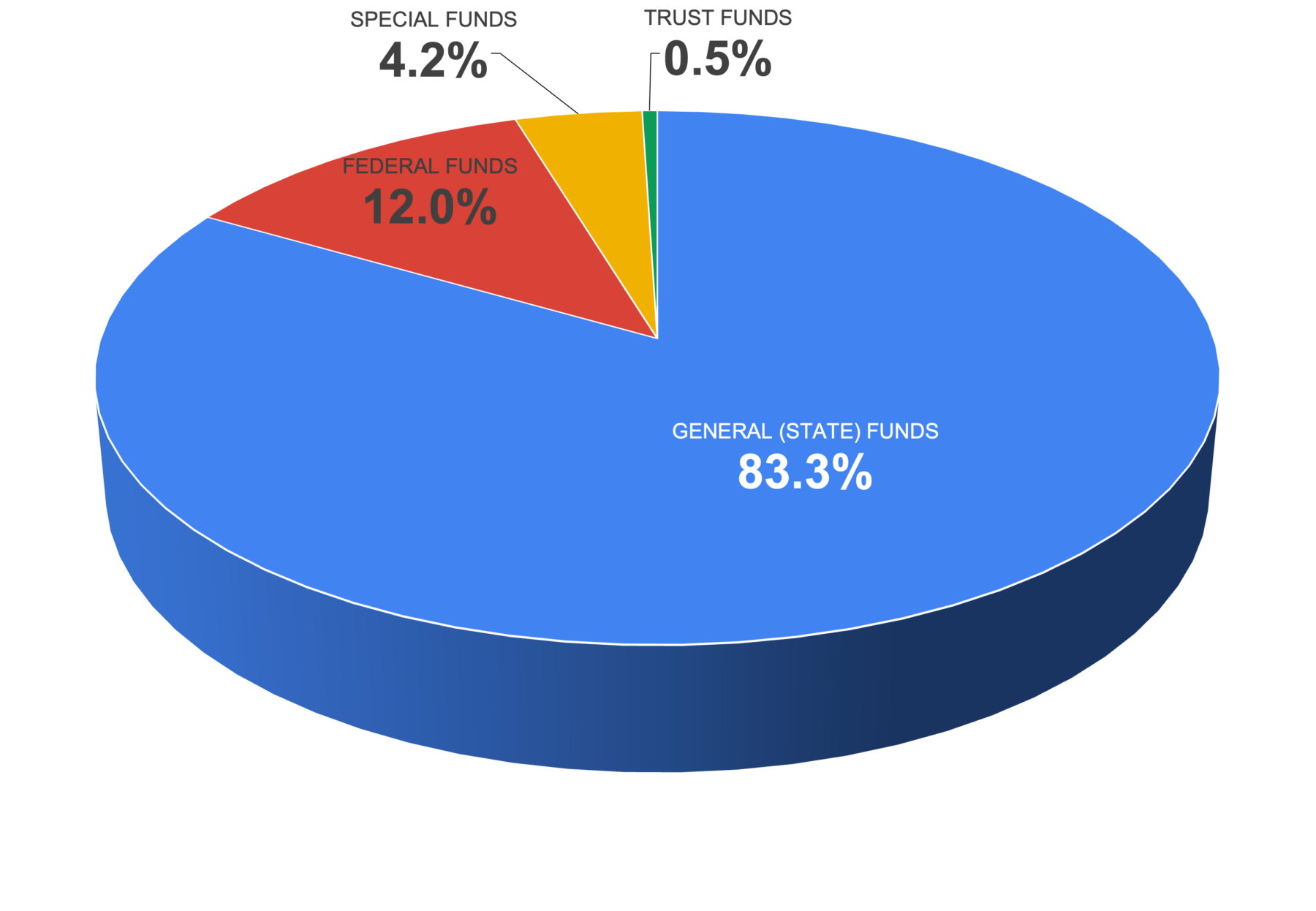
The fiscal year 2026-27 operating budget funding comes from four sources:
- 일반 기금: Represents approximately 83.3% of our funding resources. Comes from the State of Hawaiʻi’s general fund, primarily state tax revenues. This is the top source of funding to the Department.
- 연방 자금: The second largest source of funding represents approximately 12% in expenditure ceiling resources. The Department receives grants from federal agencies including the U.S. Departments of Education, Agriculture, Defense and Health and Human Services.
- 특별 자금: Roughly 4.2% of our expenditure ceiling resource is through special funds. Those coming from revenue-generating activities, including school food services, student bus transportation services, summer school program, after-school programs, adult education, driver education, and use of school facilities.
- 신탁 자금: Approximately 0.5% of our expenditure ceiling resource is through trust funds. These may include donations and gifts, foundations and other grants, school athletic program activity collections, and “fair share.”
학교 직접 자금 지원
- EDN 100 거의 전적으로 학교에 배포됩니다. 가중 학생 공식(WSF). WSF는 각 학생에 대해 특정 금액을 학교에 제공하고, 무료 및 할인 급식 프로그램(사회경제적 어려움) 자격 또는 영어 학습자 자격과 같은 특정 특성을 가진 학생에게 추가 기금을 제공합니다. 이를 통해 주 전체에 걸쳐 투명한 자금 조달 형평성 모델이 만들어집니다. EDN 100의 잔액은 운동, JROTC 및 Alternative Learning Centers와 같은 프로그램을 지원하는 데 사용됩니다.
- EDN 150 지원합니다 특수교육 개별 교육 계획이 필요하거나 이미 계획된 학생.
- EDN 400 하수도, 전기, 물, 수리, 식비 등 학교 비용을 지불합니다.
- EDN 500 공립학교의 성인 교육 프로그램에 대한 비용을 지원합니다.
학교, 지구 및 주 수준에서 자금 지원
나머지 예산은 모든 수준에서 지원을 제공하는 EDN 200과 300에 분산됩니다. 여기에는 교육 지원, 주 전체 시험, 행정 지원(인사, 기술 및 재정), A+ 및 성인 교육과 같은 커뮤니티 프로그램, 복합 지역 행정, 유치원 전 프로그램을 제공하는 조기 학습 사무실, 교육 위원회 및 교육감 사무실이 포함됩니다.
교육부 외부에서 운영되는 기관(EDN 제공)
- EDN 407 공공 도서관
- EDN 450 학교 시설 관리국
- EDN 600 헌장 학교
- EDN 612 헌장 학교 위원회 및 행정
- EDN 700 조기 학습에 대한 집행부
Non-facility general fund per-pupil funding request for charter school students
The general fund per-pupil amounts, not including charter school facilities (CIP) shall be the same as the general fund per-pupil for HIDOE schools as explained in HRS 302D-28.
- The process involves two phases, first, a budget appropriation request and then later, an allocation “true-up” to adjust for any differences.
- For the budget appropriation request, the Department of Budget and Finance Director of Finance submits to the Legislature a request based on projections for consideration in the final Budget Appropriations Act [HRS 302D-28(a) and (b)].
- The appropriation request is reflected in the Charter School’s per pupil program.
- For the budget appropriation request, the Department of Budget and Finance Director of Finance submits to the Legislature a request based on projections for consideration in the final Budget Appropriations Act [HRS 302D-28(a) and (b)].
- After the Appropriations Act is finalized, the Director of Finance ensures that an allocation “true up” is done using the October 15th student enrollment count. The true up equalizes the per-pupil funding for both entities [HRS 302D-28(c)]
- True Up Calculation from Department of Budget and Finance
- FY2025-26 (PDF)
- 2024-25 회계연도 (PDF)
- 2023-24 회계연도 (PDF)
- 2022-23 회계연도 (PDF)
- 2021-22 회계연도 (PDF)
- 2020-21 회계연도 (PDF)
- FY2019-20 (PDF)
- True Up Calculation from Department of Budget and Finance
Capital Improvements Program (CIP)
그만큼 Capital improvement Budget (CIP) budget is set by the state as part of a comprehensive program to manage state facilities, and is handled separately from the operating budget. Facilities staff work with complex area superintendents and principals to prioritize school-level needs.
Budget Allocations
Below are links to databases containing allocations for Department offices, districts, and schools. You can view the data by allocation number, program or organization.