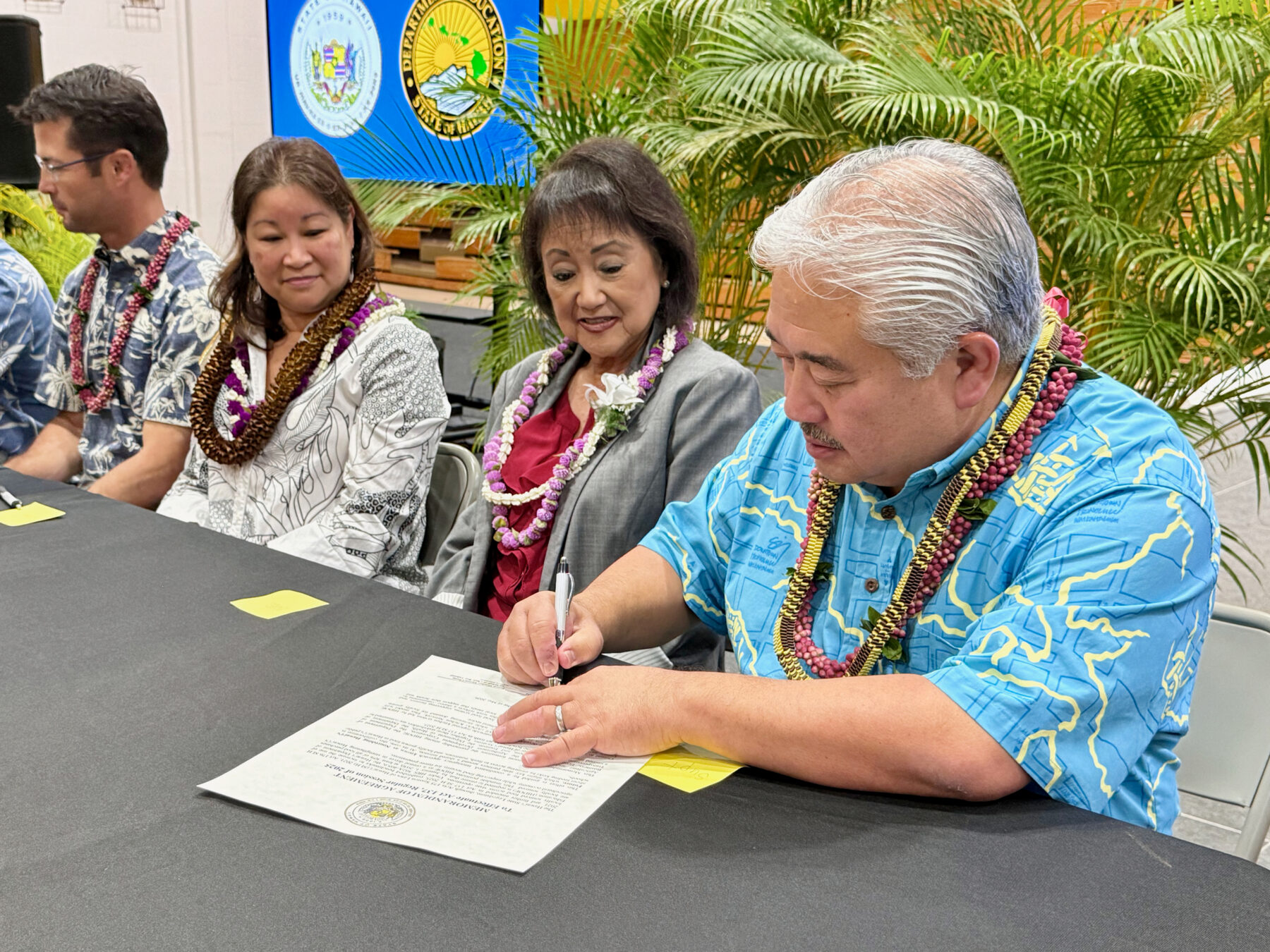
MILILANI – State leaders gathered at Mililani High School today to sign a joint memorandum of agreement formalizing a statewide partnership to expand the use of locally sourced foods in Hawaiʻi public school meals and strengthen Hawaiʻi’s agricultural and food systems.
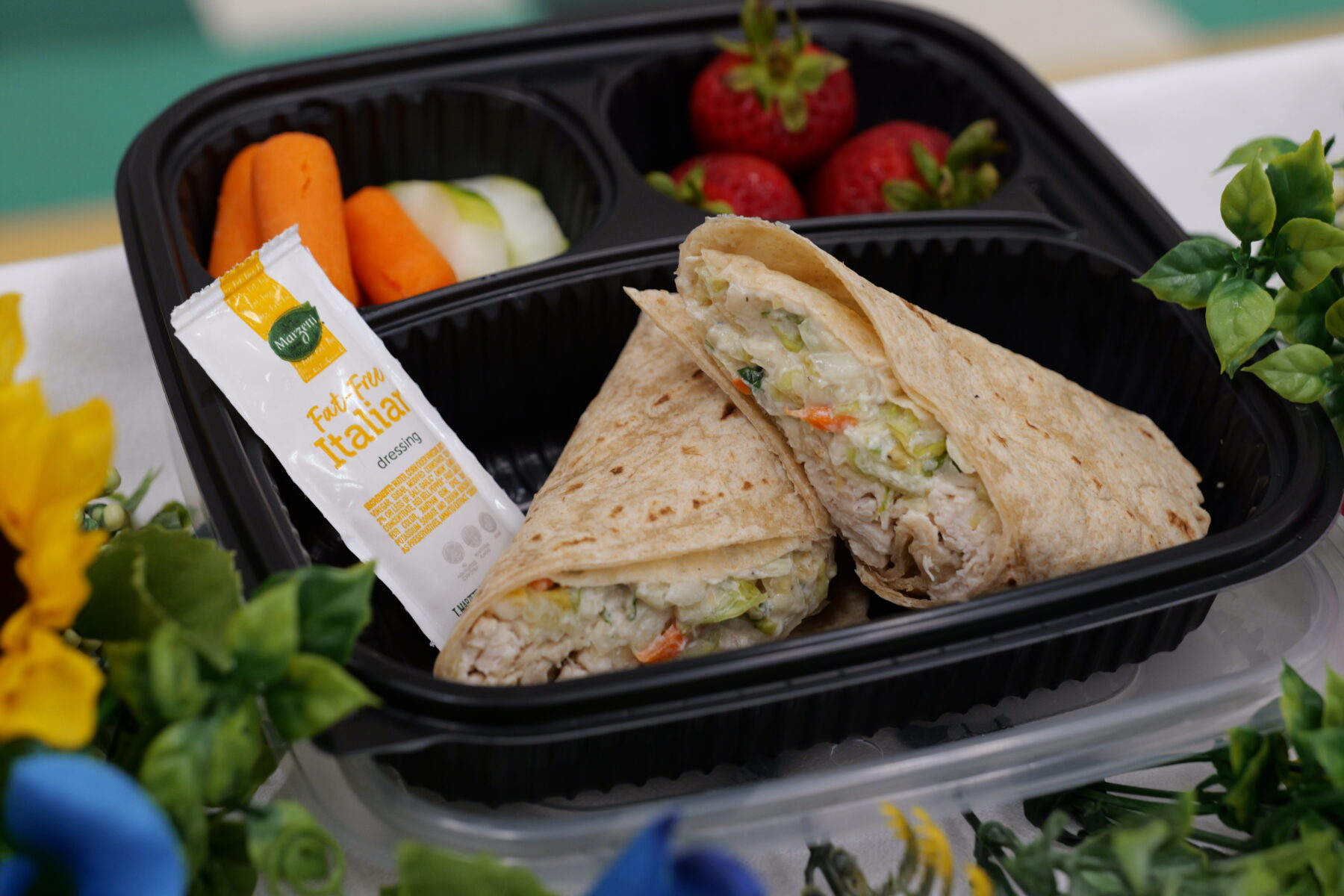
The agreement supports implementation of Act 175 (2021) and advances the Hawai‘i State Department of Education’s ongoing efforts to increase local food procurement, including its goal of sourcing 30% of school meal ingredients locally by 2030.
“Today reflects our shared commitment to feeding our keiki locally sourced, nutritious school meals, investing in our agricultural community, and strengthening the resilience of our food systems,” First Lady Jaime Kanani Green said. “This is what shared kuleana looks like. Healthy meals are an investment in Hawaiʻi’s children, their ability to learn, and their long-term well-being.”
The agreement formalizes cooperative roles and responsibilities among HIDOE, the Hawaiʻi Board of Education, the state departments of Agriculture and Biosecurity (DAB), Business, Economic Development and Tourism (DBEDT), Health (DOH), Labor and Industrial Relations (DLIR), and Transportation (HDOT), along with the Agribusiness Development Corporation (ADC), the University of Hawaiʻi College of Tropical Agriculture and Human Resilience (CTAHR), and community colleges.
“We are grateful to our fellow state agencies and our legislators for partnering with us in this work,” Superintendent Keith Hayashi said. “The Department has made steady progress in expanding the use of locally sourced foods in our school meals, and today’s agreement strengthens that momentum through coordinated statewide support for our schools, local farmers and food producers.”
The agreement establishes a framework for agencies to coordinate expertise, infrastructure planning, workforce development and agricultural scaling efforts needed to strengthen Hawaiʻi’s local food supply chain.
As part of the effort, the HIDOE will continue developing a statewide regional kitchen network to support public schools. The first regional kitchen facility, currently under construction in Whitmore Village, is expected to begin operations in fall 2027. The HIDOE serves as the lead agency for the regional kitchen initiative and is responsible for the design, construction, operations and maintenance of the statewide network.
The regional kitchen strategy is designed to increase scratch cooking capacity, improve operational efficiency, and create larger, more predictable markets for local agricultural producers.
Other participating agencies and partners will support the effort through initiatives such as agricultural mapping, crop research, workforce development, economic analysis, transportation planning and technical assistance to help local producers scale operations to meet school meal demand.
For example, DAB will coordinate statewide GIS mapping of key agricultural commodities needed for the regional kitchen network in collaboration with CTAHR and ADC. DBEDT will conduct economic studies on scaling agricultural commodities and identify funding opportunities and technical assistance for local farmers. CTAHR will create crop suitability maps to identify optimal growing regions and conduct research aimed at improving crop yields.
Each participating agency will contribute additional expertise and resources to support the state’s shared goals around local food production, student nutrition, workforce development and long-term food system resilience.
For more information, view the full agreement maanei.