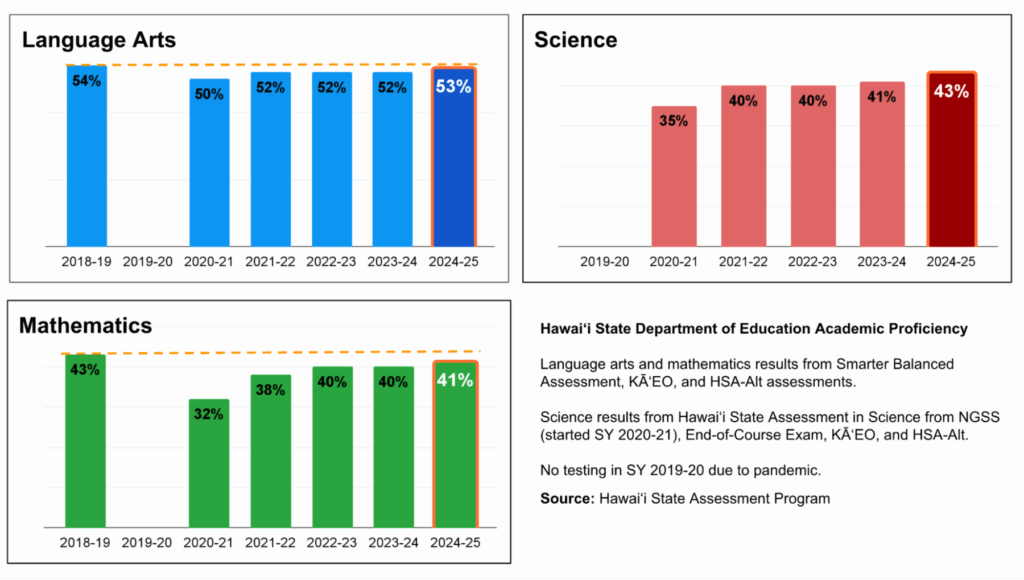
Hawaiʻi’s public schools are not only recovering from the pandemic, but showing steady progress. According to the Hawaiʻi State Department of Education’s (HIDOE) 2024-25 Strive HI Performance System report released today, students are making gains in science, math and language arts, while attendance and college enrollment are also on the rise.
“These results are a clear signal that Hawaiʻi’s public schools are on the rise,” Superintendent Keith Hayashi said. “Our students are gaining ground in every core subject and more students are showing up to school ready to learn. With last year’s gains we expect to reach academic recovery from the pandemic this year. While this is not our destination, it is an important milestone — Hawaiʻi is closer to recovery than many states. This growth reflects the hard work happening in classrooms across the state and the resilience of our students. We’ll keep investing in evidence-based practices and classroom supports that accelerate student success.”
In addition to academic achievement and growth, the annual Strive HI report provides a snapshot overview of how students are performing in such areas as on-time graduation and progress toward closing achievement gaps.
Nā hopena koʻikoʻi o ka makahiki 2024-25 Strive HI
- Moku'āina holoʻokoʻa ʻepekema ua hoʻonui ʻia ka mākaukau ma 2 mau helu i 43%.
- Moku'āina holoʻokoʻa nā hana noʻeau ʻōlelo ua hoʻonui ʻia ka mākaukau ma 1 helu i 53%.
- Moku'āina holoʻokoʻa makemakika ua hoʻonui ʻia ka mākaukau ma 1 helu i 41%.
- Maʻamau o ka moku'āina holoʻokoʻa hele ʻana increased 1 point to 76%, with gains across all student groups.
- Hoʻopaʻa inoa ma hope o ke kula kiʻekiʻe no ka Papa o 2024 ua hoʻonui ʻia he 3 mau helu i 53% — e uhaʻi ana i kahi paepae ʻehā makahiki ma 50–51%.
- Puka ʻana i ka manawa kūpono ua kūpaʻa mau ma 86%.
Pōʻaiapili Lahui
Hawaiʻi is one of 13 states that administer the Smarter Balanced Assessments for language arts and math. Of the seven states reporting achievement results for 2024-25 to date, Hawaiʻi is the state closest to academic recovery.
Ua ʻike nā loea hoʻonaʻauao ua kū i waho ka holomua o Hawaiʻi i hoʻohālikelike ʻia me nā mokuʻāina ʻē aʻe. Ma mua o kēia makahiki, he haʻawina aupuni na nā mea noiʻi ma Harvard a me Stanford i hoʻonoho iā Hawaiʻi i ka hā ma ka ʻāina no ka hoʻōla makemakika a me ka lua no ka hoʻōla heluhelu ʻana mai ka wā maʻi ahulau — e hōʻike ana i ka wikiwiki o ka hoʻōla hou ʻana o ka mokuʻāina i ke kula.
“Many states have released their assessment results this year. Some saw improved performance, while others saw declines. Hawaiʻi students have continued their upward trajectory for several years, which is rare,” said Scott F. Marion, executive director of the Center for Assessment. “Hawaiʻi students have now surpassed 2019 proficiency rates in English language arts, and they are approaching 2019 levels in mathematics. Hawaiʻi educators and leaders should be complimented for their consistent improvement.”
Nā Kūkuhi Kula
Ma waho aʻe o kahi kiʻi pōkole o ka mokuʻāina holoʻokoʻa, loaʻa i kēlā me kēia kula HIDOE kahi hōʻike hana Strive HI. Aia ma lalo iho nā mea koʻikoʻi o ʻelua mau kula i ʻike i ka ulu ʻana ma nā ana koʻikoʻi.
Kula Kuwaena o Waipahu
I nā makahiki ʻekolu i hala iho nei, ua hoʻolaha ʻo Waipahu Intermediate i nā holomua mau ma nā kumuhana āpau. Ke hoʻohālikelike ʻia me ka makahiki kula i hala, ua ʻike ʻo Waipahu Intermediate i ka piʻi ʻana o 11 mau helu ma nā ʻano hana ʻōlelo, ka piʻi ʻana o 5 mau helu ma ka makemakika, ka piʻi ʻana o 8 mau helu ma ka ʻepekema, a me ka piʻi ʻana o 4 mau helu ma ka hele ʻana mai.
Principal Alvan Fukuhara credits this success to a “whole school effort” that integrates core subjects into all classes, expands elective opportunities, and builds emotional connections with students. “Students have been seeing a lot more connections, not just learning math and literacy in isolation. They’re actually applying these concepts in all of their classes through elective courses,” Fukuhara said. “It’s a whole school effort.”
The school’s shift to a pre-academy model in 2022-23 aligned with Waipahu High School’s academies, and added new electives such as Business and Marketing, Health Services, and Teacher Education. Waipahu Intermediate is the only intermediate school in Hawaiʻi to offer all five Career & Technical Student Organizations.
“We’ve been really doing work for students to gain confidence that they’re capable of doing great things. And everything that they do is a reflection of our school and our Waipahu community,” Fukuhara said.
Ke kula kiʻekiʻe ʻo Waiʻanae
Ua loaʻa i ke Kula Kiʻekiʻe ʻo Waiʻanae nā holomua nui i kēia makahiki, me ka piʻi ʻana o ka mākaukau ʻōlelo he 20 mau helu a me ka piʻi ʻana o ka mākaukau makemakika he 13 mau helu, ke hoʻohālikelike ʻia me ka makahiki i hala.
“"Ua piʻi kā mākou mau helu (no nā hana noʻeau ʻōlelo Pelekania) mai 26 a i 46 — he piʻi ʻana o 20 mau helu. Ua piʻi kā mākou mau helu makemakika mai 8 a i 21 — he piʻi ʻana o 13 mau helu. Ua piʻi kā mākou mau helu WIDA mai 7 a i 17 pakeneka. Ma nā wahi āpau, ke neʻe nei mākou ma ke ʻano he kula, me ka nānā ʻole i nā hui e like me ka hoʻonaʻauao kūikawā a i ʻole nā Hauʻoli ʻŌlelo Pelekania," wahi a ke Poʻo Kula ʻo Ray Pikelny-Cook.
Ua hāʻawi ʻo Pikelny-Cook i ka manaʻo nui o ke kula holoʻokoʻa ma luna o ʻekolu mau hoʻolālā aʻo koʻikoʻi: nā pahuhopu aʻo o kēlā me kēia lā, nā kamaʻilio hoʻonaʻauao a me nā loiloi hoʻokumu.
“Our demographics aren’t going to change, so we had to change something we were doing,” she said. “I don’t want my teachers to discuss the reasons why we cannot; I want them to discuss the possible ways we can.”
Pikelny-Cook also said the school made a concerted effort to shift its assessment culture to encourage more collaboration not only between teachers, but between teachers and students to make testing more festive. “When students can see teachers get excited about assessments, they get excited about it too. We have to have those opportunities for teachers and for kids to be talking, really collaborating, it comes down to building that culture,” she said.
E pili ana iā Strive HI
Strive HI was launched in the 2012-13 school year as the state’s locally designed school improvement and accountability system that offered flexibility from the former federal No Child Left Behind (NCLB) law. It includes multiple measures of school performance including proficiency in science, math and language arts/literacy; attendance; academic growth; and graduation rates, reflecting key performance indicators under the Hoʻolālā Hoʻolālā BOE 2023-2029.
Hoʻolaha ʻia nā hōʻike kula ma ka ʻIkepili ARC. E nānā i ka Kiʻi o ka Moku'āina 2024-25 (PDF) o nā hōʻailona Strive HI. E aʻo hou e pili ana i ka ʻŌnaehana hana Strive HI.