Hawaiʻi public school students are nearing pre-pandemic proficiency levels in language arts and mathematics, while regular attendance continued its multi-year improvement and math proficiency increased for the fourth consecutive year, according to the Hawaiʻi State Department of Education’s 2025-26 Strive HI results.
Statewide language arts proficiency was 53.2%, compared with 54.1% before the pandemic, while mathematics proficiency reached 42.5%, compared with 43.1% pre-pandemic. Regular attendance increased to 76.8%, continuing a steady recovery from 66.1% in 2021-22.
Hawaiʻi is one of 12 members of the Smarter Balanced Assessment Consortium, which administers common assessments in language arts and mathematics to measure students’ critical thinking, problem-solving and analytical skills and their progress toward college and career readiness.
Among the eight states with 2025-26 results available to date, Hawaiʻi has the second-highest language arts proficiency rate and the third-highest mathematics proficiency rate. Hawaiʻi and Idaho are also the only two members within 1 percentage point of their pre-pandemic proficiency levels in both subjects. The results come amid broader national and international challenges in student achievement, with recent national assessments showing continued gaps in academic recovery and international assessments documenting declines in reading and mathematics performance across many countries.
While the results reflect continued recovery from pandemic-related learning disruptions, the Department told Board of Education members Thursday that proficiency will need to increase at a faster pace over the next three years to reach the Board’s 2029 targets of 65% in language arts and 50% in mathematics.
“At a time when schools across the nation and around the world continue to face challenges in student achievement, Hawaiʻi’s progress toward pre-pandemic proficiency levels is encouraging and reflects the hard work of our students, educators and school communities,” Superintendent Keith Hayashi said. “But returning to where we were before the pandemic is not our ultimate goal. We need to build on that progress and accelerate learning so that more of our students are meeting academic expectations and are prepared for success beyond high school.”
Key year-over-year 2025-26 Strive HI results
- Math proficiency continued to improve, increasing to 42.5%, up from 42.2% last year and 38.5% in 2021-22. Language arts proficiency was 53.2%, compared with 53.8% last year, while science held steady at approximately 44%.
- Regular attendance improved for the fourth consecutive year, reaching 76.8%, up from 66.1% in 2021-22.
- On-time graduation remained at 87% based on preliminary Class of 2026 results, up from 85% for the Class of 2022.
- Postsecondary enrollment was 51% for the Class of 2025, down from 53% for the prior class.
Attendance gains support stronger student outcomes
Regular attendance increased for the fourth consecutive year, from 66.1% in 2021-22 to 76.8% in 2025-26. The latest Strive HI data also reinforce the connection between attendance and student success: students who attend at least 90% of instructional days demonstrate substantially higher proficiency and graduation rates than students who do not attend regularly.
Accelerating progress toward 2029
With proficiency nearing pre-pandemic levels, the Department’s focus is shifting from recovery to acceleration. Statewide instructional priorities in language arts, mathematics and special education are centered on high-quality curriculum, targeted coaching and professional development, and earlier identification and support for students who need additional help.
Schools are also strengthening their use of student and instructional data to identify root causes, implement targeted strategies, monitor whether those strategies are working, and adjust when they are not.
School Spotlights
In addition to a statewide snapshot, each HIDOE school receives a Strive HI performance report. Below are highlights of three schools that have seen growth on key metrics.
Mililani ‘Ike Elementary School
At Mililani ʻIke Elementary, more than 90% of students met or exceeded standards in all three core subjects — language arts, math and science. Principal Lynne Ajifu credits the results to her team’s commitment to the school’s core values of Integrity, Kindness and Excellence, along with a culture of collaboration focused on meeting the needs of every student.
Every six days, teachers come together to review student data, discuss what is and isn’t working, and adjust instruction and supports. Particular attention is placed on early literacy in grades K-2, allowing teachers to identify and address learning gaps early and build a strong foundation for future learning.
Across grade levels, teachers also work together to align what students are learning and how their progress is measured. In language arts, early-grade instruction emphasizes foundational reading skills through small-group and individualized learning. In math, teachers examine how students reason through problems and adjust pacing and instruction based on student needs, with an emphasis on problem-solving and deeper mathematical understanding. In science, hands-on learning and engineering design connect classroom concepts to real-world applications.
Over the past three years, the school has demonstrated consistent growth in language arts (88%, 91%, 92%), math (82%, 89%, 91%) and science (74%, 84%, 94%). Science has been a particular area of focus, with proficiency rates increasing significantly from the mid-70s prior to the 2024-25 school year to 94% most recently. The growth reflects the school’s sustained efforts to strengthen instruction and improve student outcomes.
“There isn’t one program or strategy behind these results. It’s our teachers, educational assistants and support staff working together consistently, looking at each student and asking, ‘What does this child need from us next?’” Principal Lynne Ajifu said. “That collaboration and our focus on building strong foundations early allow us to maintain high expectations while giving every student the caring support they need to succeed.
Waiākea High School
At Waiākea High School, a teacher-led effort to rethink mathematics instruction is helping produce significant gains in student achievement. Math proficiency increased 8 percentage points in 2025-26, while language arts proficiency increased 10 percentage points.
The work began about five years ago as a grassroots effort among teachers looking for ways to make math classrooms more engaging. Inspired by Peter Liljedahl’s Building Thinking Classrooms in Mathematics, teachers began shifting away from lessons centered primarily on students watching and listening and toward classrooms where students actively solve problems together.
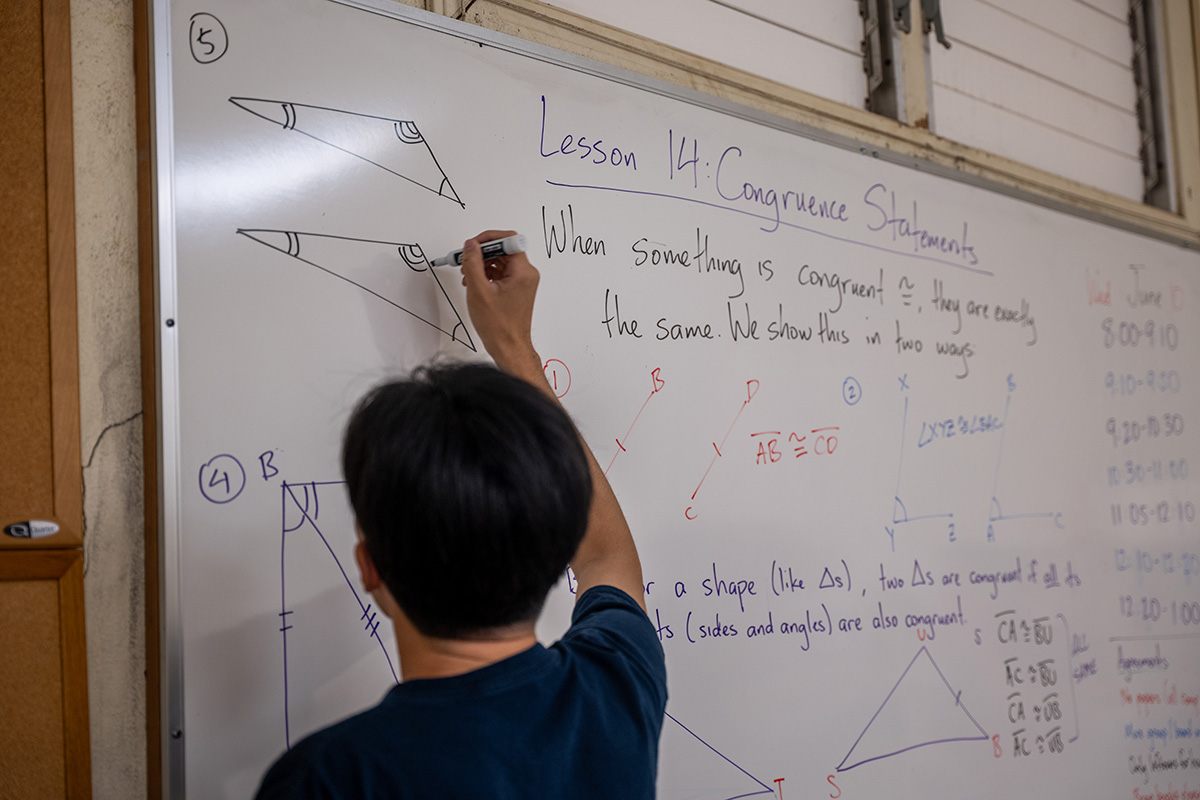
Under that model, students work in randomly assigned groups of three, often standing together at whiteboards or other erasable surfaces as they tackle math problems, explain their thinking and learn from one another. The approach is designed to get every student actively engaged in thinking, problem-solving and mathematical discussion.
Teachers say the shift has been supported by Principal Kelcy Koga’s emphasis on creating a school culture where educators have the freedom to experiment with new instructional approaches and learn from what works.
While improved test scores are an encouraging result, Koga said the larger goal is preparing well-rounded students with the skills they need for college, careers and life after high school.
That focus extends beyond the classroom through Waiākea’s wall-to-wall academy model, with every student belonging to one of five career academies. Career readiness is also embedded throughout students’ four years through the school’s senior project, which begins with planning and exploration during freshman year and culminates in a completed project during senior year.
“Relevance is one of the most important things in education,” Koga said. “That’s what I try to express to the staff—it’s about making it real and bringing in whatever the content area is—that it has everything to do with working and life in general.”
Waimea High School
At Waimea High School, a clear vision and sustained focus on student support are helping drive gains in student achievement. From school year 2024-25 to school year 205-26, the school saw an 8 point increase in language arts proficiency — exceeding the state’s baseline for the first time — as well as a 14 point increase in math proficiency and a 10 point increase in science proficiency from the school year 2024-25. Waimea’s goal that 100% of students graduate reading at or above grade level and are enrolled, employed or enlisted by graduation guides how staff invest their time and resources.
The school has taken a coordinated approach that includes schoolwide literacy strategies, targeted reading and math interventions, regular data reviews, teacher professional development and classroom walkthroughs focused on effective instructional practices. Staff have also strengthened attendance monitoring and follow-up, while weekly student support meetings help identify students who need additional support and connect them with interventions. The school’s attendance rates have steadily increased over the past five years.
Principal Mahina Anguay also credits the school’s 4-by-4 bell schedule, which allows students to focus on four classes at a time and meet with their teachers every day. The schedule has helped students stay connected to their learning while making it easier to expand Early College opportunities with Kauaʻi Community College. Nearly half of Waimea students participate in Early College courses, and the school expects its first cohort of students earning associate degrees to complete their degrees this school year.
“These gains are the result of a lot of hard work and dedication from our teachers and staff,” Anguay said. “Our 100% vision keeps us focused on what matters most: making sure every student is prepared for what comes next. The data help us celebrate our progress while also showing us where we need to keep improving.”
About Strive HI
Strive HI was launched in the 2012-13 school year as the state’s locally designed school improvement and accountability system that offered flexibility from the former federal No Child Left Behind (NCLB) law. It includes multiple measures of school performance including proficiency in science, math and language arts/literacy; attendance; academic growth; and graduation rates, reflecting key performance indicators under the 2023-2029 BOE Strategic Plan.
School-level reports are posted on the ARCH database. View the 2025-26 State Snapshot of Strive HI indicators. Learn more about the Strive HI performance system.