
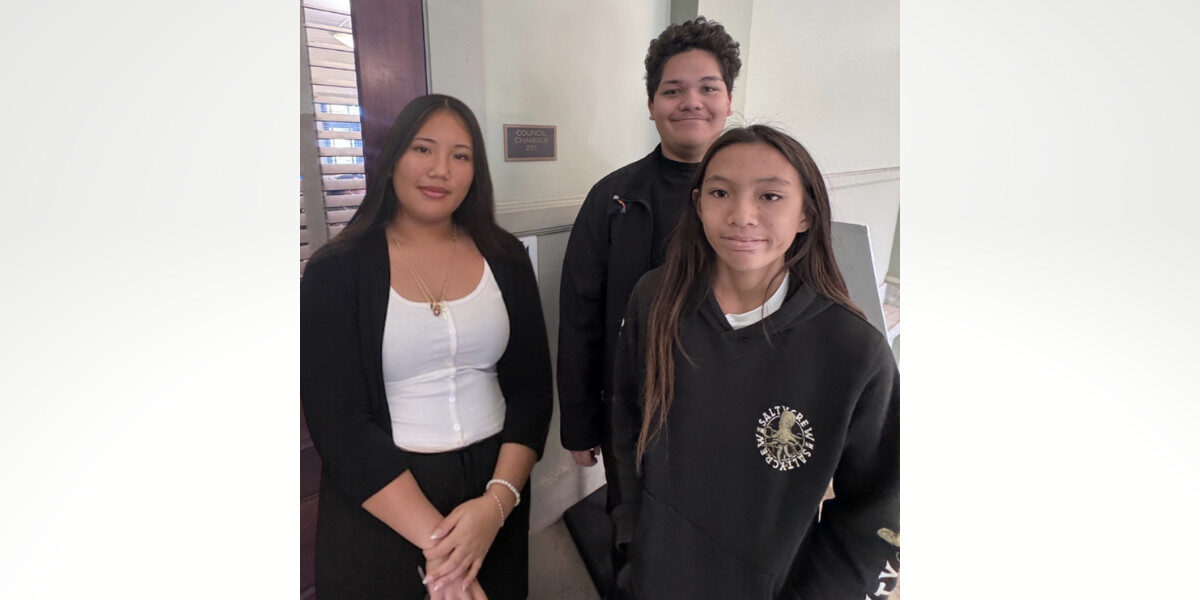
By Caleb Saiki-Fabro, Chiefess Kamakahelei Middle School
On Jan. 5th, I attended an advocacy training for Kaua‘i youth in grades 6th through college. The training was hosted by the Coalition for a Tobacco-Free Hawai‘i and the Ho‘okele Coalition. The Ho‘okele Coalition focuses on keeping substances such as marijuana and alcohol out of the hands of youth and the Coalition for a Tobacco-Free Hawai‘i does the same thing but for tobacco and nicotine through education and policy change. Auntie Val from the Coalition for a Tobacco-Free Hawai‘i led the training by sharing stories and showing examples of how youth can make a change in our community even though we are not old enough to vote or run for office. The training also featured two guest speakers: Ken Herman, the County of Kauai’s Liquor Control Investigator and Kaua‘i County Council Chair Mel Rapozo.
This training taught me that advocacy is about taking a cause that you believe in and how to get others to join to support your movement to create a positive change in your community. A couple ideas that were discussed in the training were movements such as ending the sale of flavored tobacco products, ending the sale of disposable vape products, and restoring county authority regarding the sales of tobacco products.
Something I found interesting at the training was learning about the proper procedures and protocols to make a policy change. There are many steps to complete but you start by having an idea, then develop and spread that idea by educating the community and strategically talking to people whose roles can make your idea a reality. The big picture was taking an idea and crafting it into something that will interest people to support your cause.
I also learned that your idea can be something that could help protect people such as stopping stores from posting tobacco ads within 1,000 feet of a school so kids are not exposed to tobacco ads on the way to and from school.
When it’s time to submit a testimony, you do not need to state facts that the lawmakers already know or can research, instead it’s more powerful to share your personal opinion or a personal story so lawmakers know why the change is important to you and your community.
To help endorse your policy, you should plan to gather support by writing letters to the editor for the newspaper, author articles or get an interview from the media by sending out a press release for community events about your issue.
We were also taught that if we want to implement any change we must also consider enforcement. Mr. Herman, the liquor control investigator, talked to us about fake IDs and how to tell them apart from the real IDs. He then asked us what we think should happen to people who are underage and use fake IDs, and can it be implemented. This helped us think about the enforcement part of proposing any type of policy change.
During the training, Council Chair Mel Rapozo invited us to attend the first Kaua ‘i County Council meeting of the year on the morning of Jan. 7. At the meeting, we were able to see the proper protocol of a council meeting. From how the meeting is called to order and how the council calls up experts to provide facts regarding each subject and then asking the audience if anyone would like to provide testimony on the agenda item.
I think students should take this training because they can learn how to support good ideas and the proper procedures to introduce and advocate for the change they want to see in their community.
At the end of this two-day training experience, I learned advocacy is not about passing laws and creating restrictions. It’s about recognizing needs in our community, educating and engaging people of all ages in order to create positive change to make Kaua‘i the best place to live.

Caleb Saiki-Fabro is an eighth grader at Ke kula waena o Kamakahelei Alii. He participates in a number of youth programs, including the Coalition for a Tobacco-Free Hawai‘i’s Youth Council, Ho‘okele Coalition, Boys and Girls Club and Lili‘uokalani Trust. In his spare time, he plays soccer for Kaua‘i’s BVB soccer club. He also enjoys volleyball, running, riding his bike and practicing the shot put. When he’s at home, he likes to play Roblox BedWars while hanging out with his cat, Quarter.